Corrected Claim vs. Reconsideration vs. Appeal: Which One to Use
When to send a corrected claim (frequency code 7 or 8), when to ask for reconsideration, and when to file a formal appeal, including Medicare reopenings and appeal deadlines.
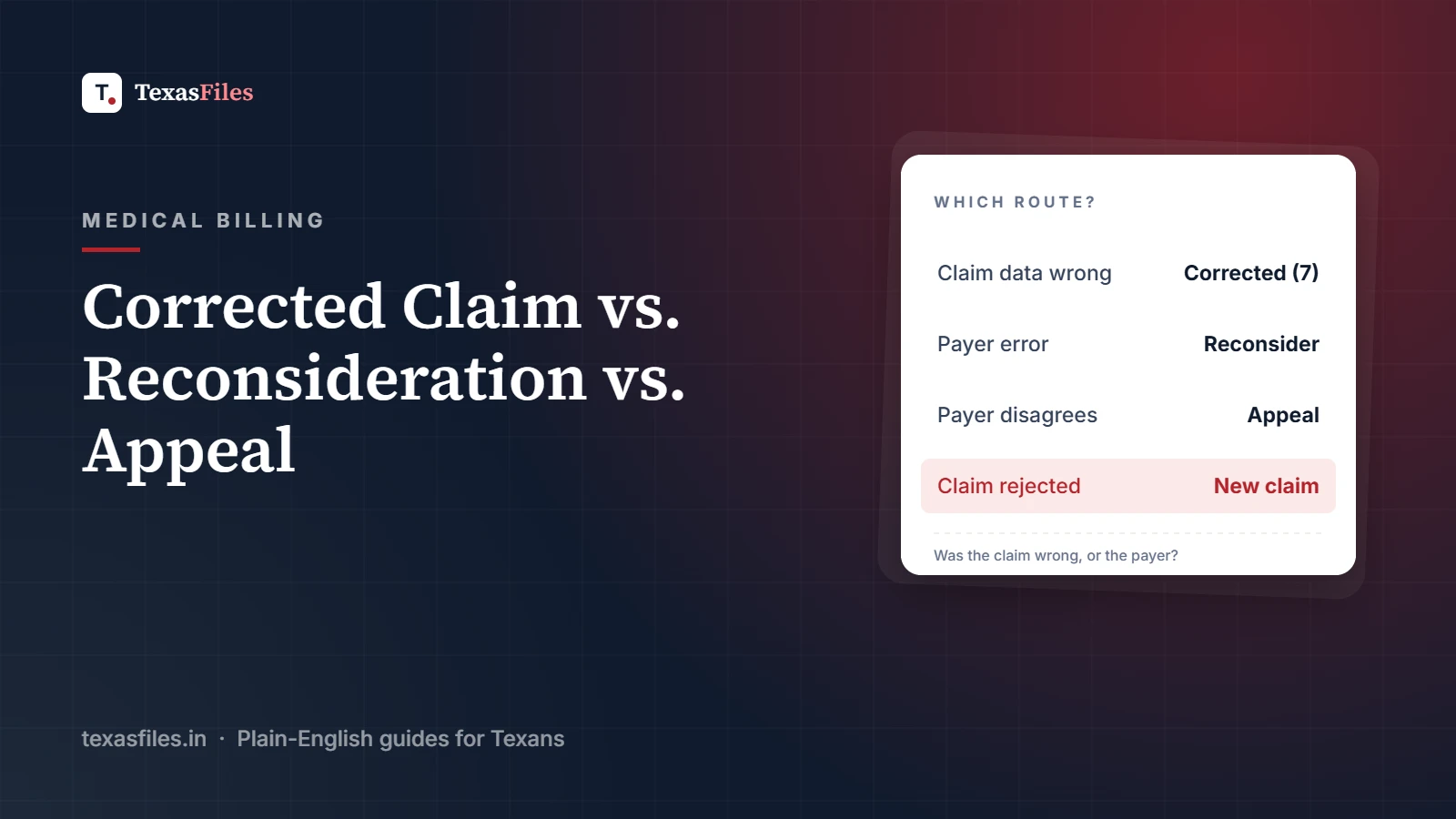
When a claim comes back denied or underpaid, billers have three main tools: send a corrected claim, ask for a reconsideration, or file a formal appeal. Picking the wrong one is one of the most common reasons denials drag on for months. An appeal for a coding error gets bounced back. A corrected claim for a medical necessity dispute changes nothing. A new claim sent instead of a replacement creates a duplicate denial.
Here is how to choose the right route, how each one works, and the mistakes to avoid.
The Short Answer
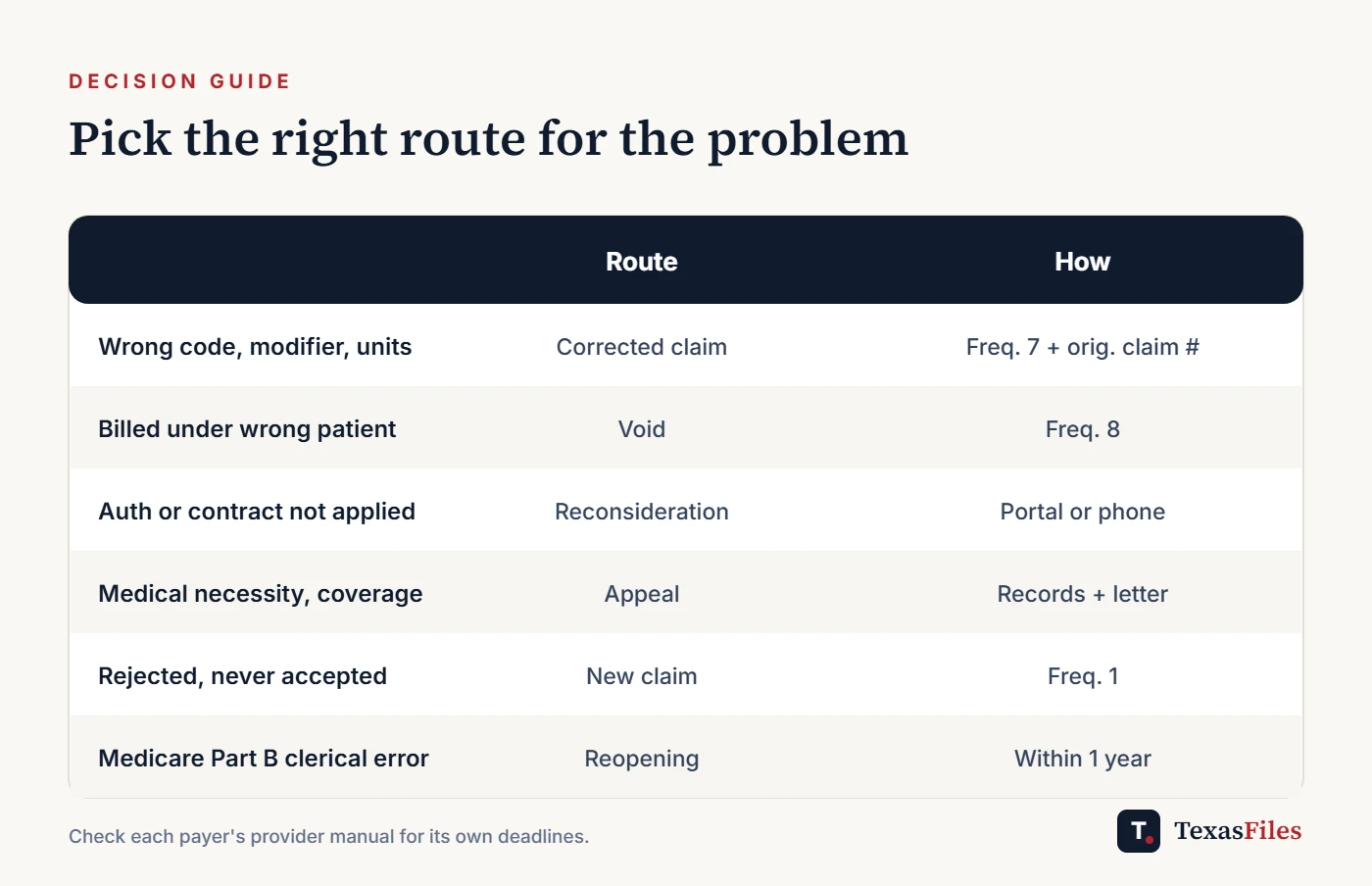
Something on the claim was wrong (code, modifier, units, diagnosis, date, provider, patient data): send a corrected claim.
The claim was right, but the payer processed it wrong (wrong fee schedule, didn't apply an authorization, ignored a modifier): ask for a reconsideration or reprocessing.
The claim was right and the payer disagrees on substance (medical necessity, coverage, experimental, level of care): file an appeal with supporting records.
The claim was rejected and never accepted by the payer: fix it and send it as a new claim.
Corrected Claims (Replacement and Void)
A corrected claim replaces a claim the payer already processed. You don't send it as a brand-new claim. Instead, you tell the payer which claim it replaces using a claim frequency code and the payer's original claim number:
Frequency code 7 (replacement): replaces the original claim entirely. Send the full claim with every line, not just the corrected line, because the replacement overwrites the original.
Frequency code 8 (void/cancel): cancels the original claim, for example when it was billed under the wrong patient or provider.
Frequency code 1 is an original claim.
On the CMS-1500, the frequency code goes in item 22 (resubmission code) with the original reference number. On the 837P electronic claim, it's the third part of CLM05, and the payer's original claim number goes in a REF*F8 segment.
When to use it: wrong CPT or ICD-10 code, missing or wrong modifier, wrong units, wrong date of service, wrong rendering provider, a charge you forgot to bill, or a CO-16 denial asking for missing information.
Watch out: many payers set a separate deadline for corrected claims, which may be measured from the original processing date. Check the payer's provider manual.
Medicare Part B Works Differently
Traditional Medicare handles corrections through reopenings, not the commercial-style corrected claim process most billers know. CMS rules say clerical errors, such as a transposed code, wrong modifier, wrong date of service or math error, "must be processed as reopenings rather than appeals."
A reopening can be requested within one year of the initial determination for any reason, and within four years for good cause.
Many Medicare contractors let you request clerical reopenings by phone, through their provider portal, or through the interactive voice response system.
If a claim was returned as unprocessable (for example with remark code MA130, which says no appeal rights are afforded), fix it and submit a new claim instead.
Forgetting to bill a service is not a clerical error. Submit a new claim for the missed line.
Reconsiderations and Reprocessing Requests
Many commercial payers offer a first, informal step before a formal appeal, often called a reconsideration, reopening, or claim dispute. This is the right tool when the claim was correct but the payer made a processing error, such as:
An authorization was on file but not applied.
The allowed amount doesn't match your contract.
A modifier was billed correctly but ignored.
Coordination of benefits was updated and the claim needs to be reprocessed, a common fix for CO-22 denials.
Simple reprocessing requests can often be handled on a phone call or through the payer's portal. Always note the call reference number, the representative's name, and the promised turnaround in your claim notes.
Formal Appeals
An appeal is a request for the payer to change its decision. It's the right route when there is nothing to correct on the claim and the payer disagrees with you on substance: medical necessity (CO-50), non-covered service, experimental treatment, level of care, or a timely filing denial where you have proof.
Commercial and employer plans: for employer-sponsored group health plans covered by ERISA, federal rules require that claimants get at least 180 days after an adverse benefit determination to appeal, and post-service appeals are generally decided within 60 days. Providers usually appeal under their contract's provider dispute process, which can have shorter deadlines, so check the provider manual. Patients can also appeal their own denials; our guide on how to appeal a denied claim in Texas and free appeal letter generator walk them through it.
Traditional Medicare has five appeal levels:
Level 1, Redetermination by the Medicare Administrative Contractor: request within 120 days of receiving the initial determination (receipt is presumed 5 days after the notice date).
Level 2, Reconsideration by a Qualified Independent Contractor (QIC): request within 180 days of receiving the redetermination decision.
Level 3, Decision by the Office of Medicare Hearings and Appeals.
Level 4, Review by the Medicare Appeals Council.
Level 5, Judicial review in federal district court.
A strong appeal is short and specific: identify the claim, quote the denial reason, explain in a few sentences why it's wrong, and attach the evidence (records, a letter of medical necessity, the authorization, the policy section, or proof of timely filing).
Common Mistakes
Sending a correction as a new claim. The payer sees a second claim for the same service and denies it as a duplicate (reason code 18).
Correcting only one line on a frequency 7 claim. The replacement overwrites the whole original, so lines you left off can be recouped.
Appealing a data error. Appeals take longer and many payers will tell you to send a corrected claim anyway.
Missing the original claim number. Without the payer's claim number in REF*F8 or item 22, the replacement can't be matched.
Letting deadlines slide. Corrected claim, reconsideration and appeal windows are all separate and all shorter than you'd like.
Frequently Asked Questions
What is the difference between a corrected claim and an appeal?
A corrected claim fixes information you submitted wrong. An appeal asks the payer to change its decision on a claim that was submitted correctly.
What is claim frequency code 7?
Frequency code 7 marks a replacement of a prior claim. It goes in item 22 of the CMS-1500 or CLM05-3 of the 837P, along with the payer's original claim number.
Can I send a corrected claim to Medicare?
For Part B, Medicare generally handles clerical errors through reopenings rather than commercial-style corrected claims. Claims returned as unprocessable are fixed and submitted as new claims.
How long do I have to appeal a Medicare denial?
For a Level 1 redetermination, 120 days from receiving the initial determination. Receipt is presumed to be 5 days after the date on the notice.
The Bottom Line
Ask one question before you act: was the claim wrong, or was the payer wrong? If the claim was wrong, correct it. If the payer processed a correct claim wrong, ask for reconsideration. If the payer disagrees on the merits, appeal with evidence. Choosing correctly the first time is the fastest way to get paid.
Sources
Written by Ashim
Ashim works in US medical billing and revenue cycle management, handling claim follow-up, denials and appeals every day.
Read our editorial policy. Spotted something outdated? Tell us.
Keep reading
Common Causes of CO-97 Denials (and How to Fix Them)
CO-97 means the payer bundled a service into another one. Learn the common causes, like NCCI edits, missing modifiers, and global periods, and how to fix them.
·4 min read
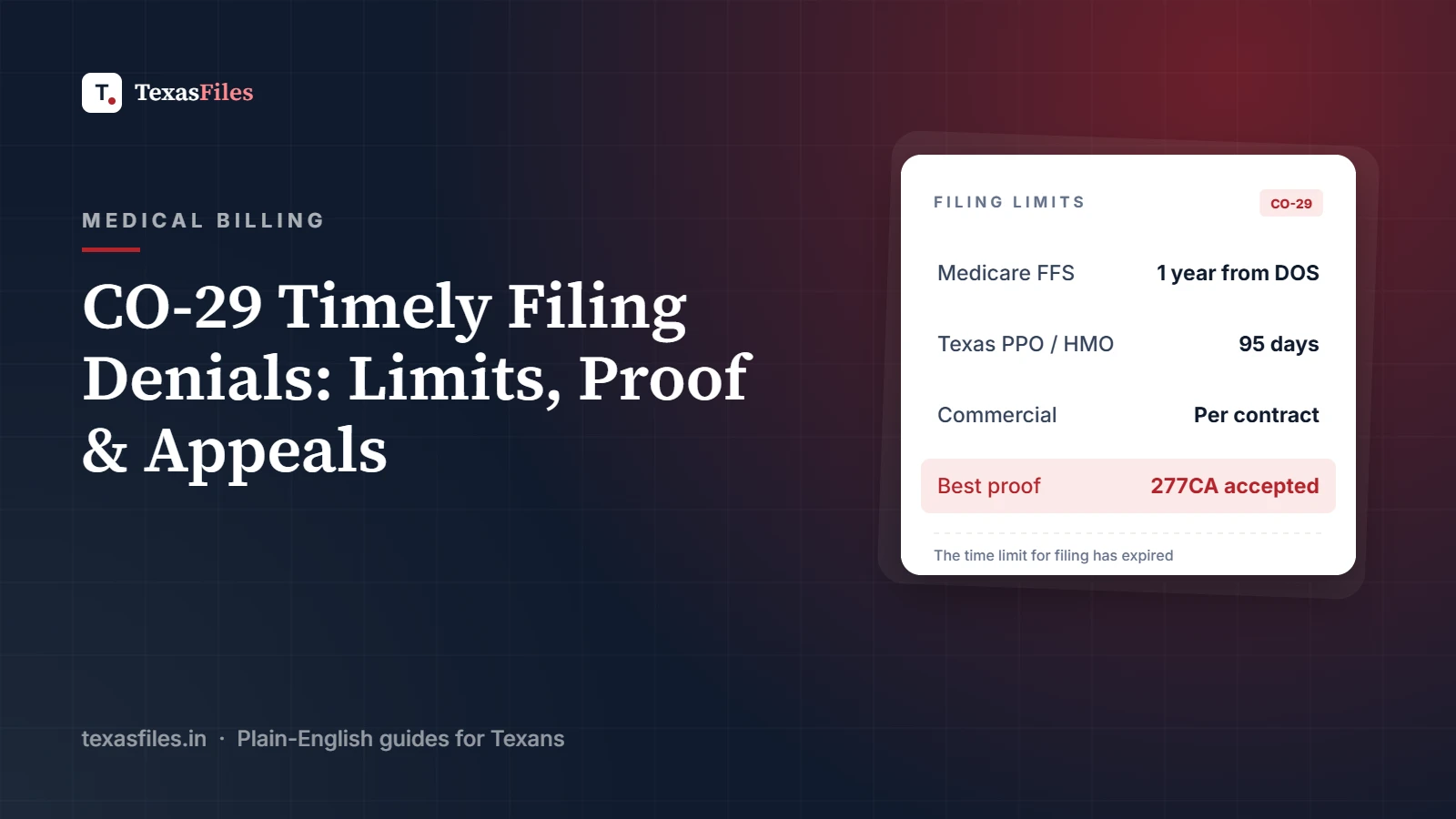
CO-29 Timely Filing Denials: Filing Limits, Proof, and How to Appeal
What a CO-29 timely filing denial means, Medicare's one-year limit, Texas's 95-day rule for insured plans, what counts as proof of timely filing, and how to appeal.
·5 min read
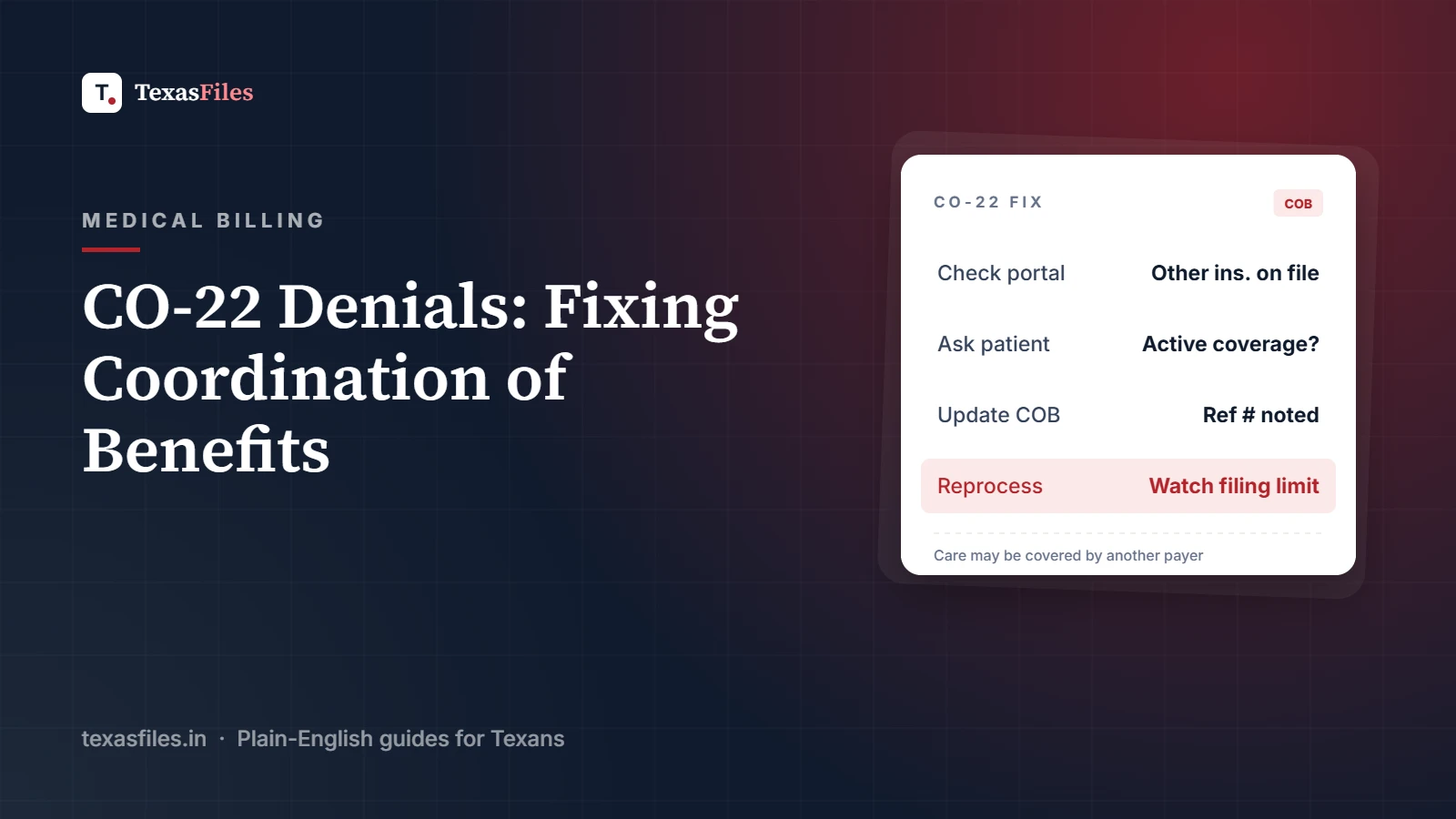
CO-22 Denial: How to Fix Coordination of Benefits Denials
What a CO-22 denial means, who pays first under COB and Medicare Secondary Payer rules, and a step-by-step process to get COB updated and claims reprocessed.
·6 min read